
There’s a misconception that a Montessori education is an everyday free-for-all. In reality, it’s more of a choose-your-own-adventure within the boundaries of a carefully tailored environment. In every classroom, the teacher lays out what needs to be accomplished and it’s up to the student to get there.
There are three major elements of every Montessori classroom that help achieve this goal: a prepared environment, uninterrupted work time, and multi-age classes.
A prepared environment gives students a physical space designed for them to learn. Uninterrupted work time opens up the opportunity to explore their interests. And multi-age classes encourage students to work with and learn from their peers and mentors.
Together, these three elements shape the Montessori experience and build the critical skills of independence, problem-solving, and collaboration. Here’s how each element plays out in practice.
Prepared Environment
Every day, students step through the threshold of their classroom to find a space designed for them to learn. “Children acquire knowledge through experience in the environment,” said Dr. Montessori.
There is a subtle harmony to every classroom with open spaces to work together and each learning material in its proper place. Math materials live together, furniture is designed for the ages of the classroom, and there’s an organic flow teeming with calming color palettes and real-life objects. And each classroom expands with more materials as children advance through the curriculum.
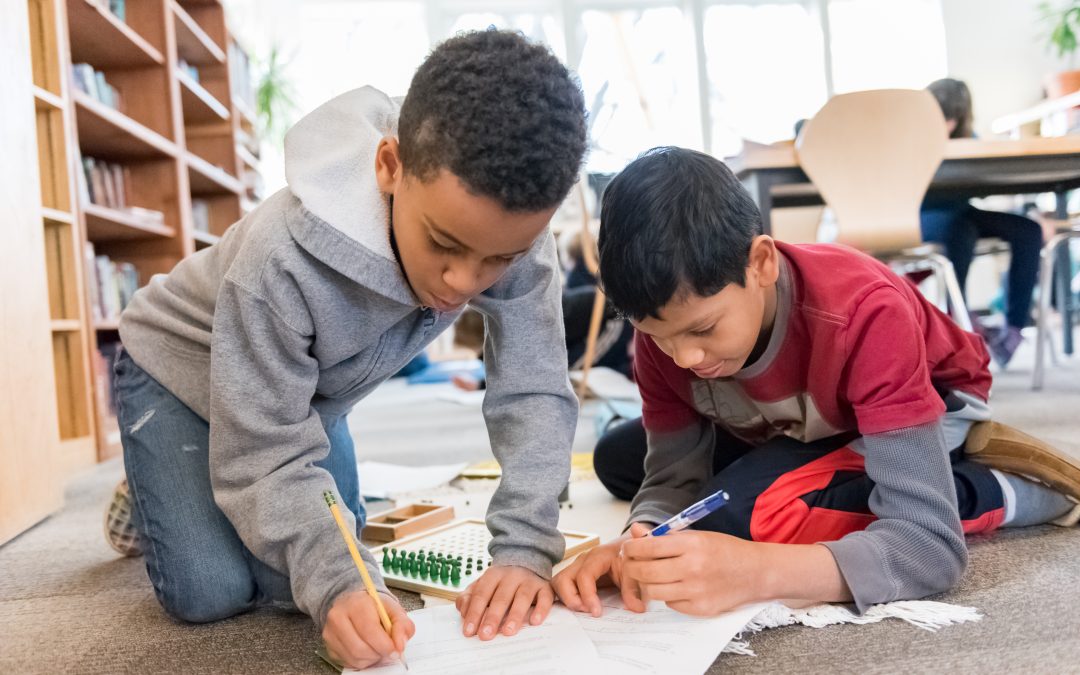
One of the starkest differences between a Montessori classroom and the prevailing image of an elementary classroom is the complete lack of desks. Students have the autonomy to move around the classroom and can do their work on a work rug on the floor or at a table, but they aren’t restricted to an assigned desk in a row. The prepared environment of a Montessori classroom silently sets the stage for students to experience the freedom of movement, choice, and time.
Uninterrupted Work Time
In many schools, lessons command much of the school day. But during a Montessori school day, the lesson is just the launchpad.
The three-hour uninterrupted work time period is essential. In her work as a Montessori consultant, Irene Baker was told by one teacher, “Protect the three-hour work period with your life! It’s one of the most important ingredients in our method.”
This part of the day produces a number of benefits. The first is building the skills of deep focus and concentration. In her work, Dr. Montessori found the last hour especially important. This is where students chose more challenging work. It’s also where they begin to explore specific elements of a lesson that interest them.
That exploration can be infectious. Currently, in Upper Elementary, there is a fascination with the periodic table that is sweeping the classroom. It all spawned from one student’s spark to learn everything there was to know about the elements before wanting to create his own custom periodic table. Now he’s onto chemical reactions and the other students can’t wait to move through their lessons to join him.
These work cycles yield more frequent “aha!” moments, which snowball into a deeper understanding of the material and more fully developed passions. Chasing curiosities is built into the curriculum.
Multi-Age Classrooms
In a Montessori classroom, students advance through lessons at their own pace. This is to the benefit of everyone. Students who are ready for the next lesson aren’t waiting to move on and students who need more time don’t have the stigma of falling behind. As such, there is no academic reason to group children according to one grade level and students can always find peers who are working at their current level. But there are so many reasons why multi-age class groups benefit everyone in the classroom.
Multiple years in the same classroom means repeated exposure to the curriculum and a deeper understanding of all subjects. When students see a lesson for the second or third time, they make connections to prior years, pick up details they missed before, and fill in information for students new to the materials. This also means that the curriculum must accommodate the entire span of interests and abilities up through the oldest and most accelerated students in the class. This creates a highly enriching learning environment that’s both equitable and collaborative.
Multi age classrooms allow for deeper social connections. Classrooms and friendships are strengthened with time together. In that time, teachers get to know students better and vice versa, older students learn to be mentors, younger students turn to their peers for help, and the group becomes a unit.
In Lower Elementary, the mentorship program is foundational to the class. For older students, it builds leadership qualities and offers a new way to master their skills. For younger students, it provides an exciting new way to learn a lesson from a peer they look up to.
The Lower El mentorship program is based on the complementary strengths and interests of older students and younger students. Before the year, older students spend two days training how to recognize anxiety and help with everything from finding the pencils to opening a thermos to assisting in a lesson.
The relationship is often so tight knit it extends beyond the classroom and even the school year. In fact, we know mentors and mentees that still keep in touch years after leaving MSN.
Amazing things happen when you empower a student to take control of their education and design a space with that experience in mind. In the Montessori classroom, amazing is a daily occurrence.