
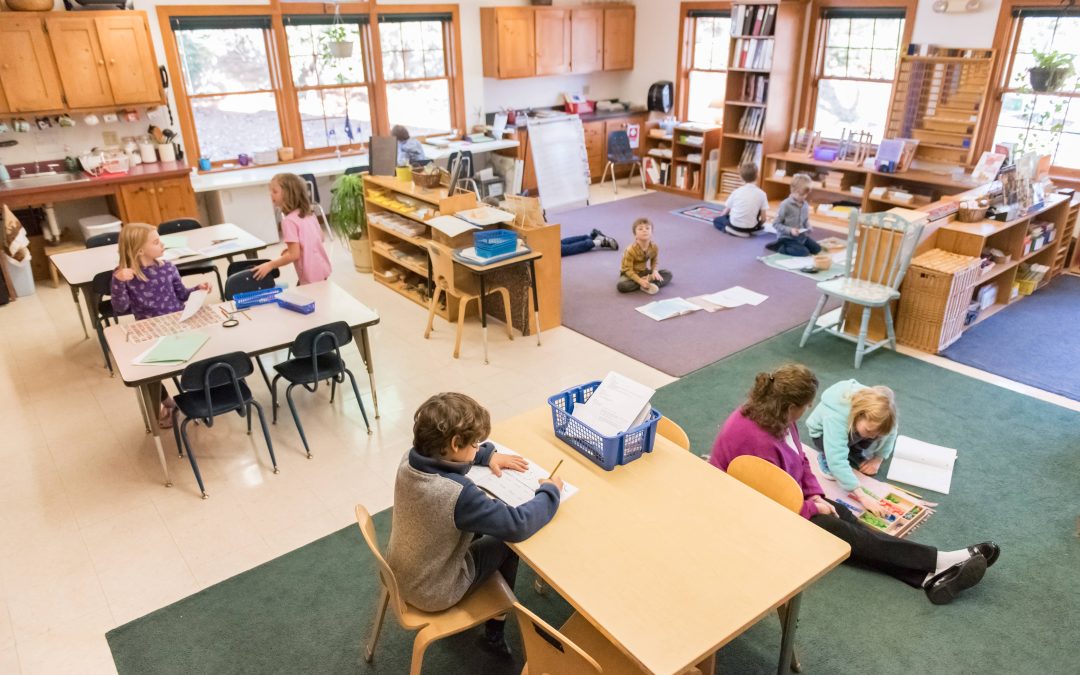
It’s a typical morning in Montessori Lower Elementary. In one area, a few students are reading. In another, a group is working on a science project. And in the center of the room, the teacher is walking through a math lesson with yet another group of students. What appears to be a free-for-all is each student on a self-directed learning journey.
The Lesson Launchpad
The journey starts with a lesson led by the teacher. In Montessori Elementary, the curriculum is anchored by The Great Lessons. At the beginning of the year, a Great Lesson on the Big Bang sets the tone for what Maria Montessori deemed “the cosmic curriculum” of the elementary years. The Big Bang transitions to lessons on the stars, electricity, chemistry, and the formation of mountains and volcanoes.
Every few months, the Great Lesson shifts. From the Big Bang to the Coming of Life, the Coming of Human Beings, the Story of Writing, and the Story of Numbers, these lessons spark the imagination and curiosity of students whether they are learning them for the first time or the third.
But the lesson is just that, the spark. What fuels the fire of discovery is the daily work cycle.
Learning to Learn
The Montessori work cycle is an uninterrupted 2-3 hour block where children choose their own activities stemming from the teacher-led lesson. Using the prepared classroom around them, they’re encouraged to use the books and resources to conduct their own research, analyze findings, and draw conclusions.
They learn how to learn.
Now this doesn’t mean that students can do whatever they want academically. They’re given a study plan for the day or week which encompasses the basic tasks they need to complete based on where they are in the curriculum. But they’re able to choose a large degree of what they investigate in that framework. They also have the ability to set their own schedule during class time. Little do they know, they are getting their first experiences with time management and meeting deadlines.
Beyond these individually-tailored assignments, children are free to explore the topics that capture their imagination and share all they’ve learned with their classmates.
Montessori teachers are not looking for the right answers. They’re trying to ask the right questions. Their responsibility is to challenge students to find new solutions on their own. Learning how to learn develops an enterprising mindset that will prepare them well for the world ahead. When learning becomes as natural as breathing, students voluntarily decide to learn new things and this impulse leads them to engage the material with passion which leads to a greater mastery.