There are no letter grades in a Montessori classroom. No quizzes or midterms, either. That leads to a frequent and fair question from parents: “How do you keep track of how each student is doing?”
From Lower Elementary and up, there are four major ways of tracking how a student is grasping a subject: diligent record-keeping, observation, mastery assessment, and self-assessment. These methods combine to track progress on a daily, weekly, and even yearly basis and give an accurate read on the command each student has of the subjects they are learning.
Here is what tracking progress looks like through the eyes of a Montessori teacher.
Record Keeping
The year starts with a high-level checklist of the lessons and follow-up work students in each grade level are expected to complete throughout the year. These lists are adjusted for prior knowledge and as needed in all subject areas. A first grader and a returning second grader will both learn about the Big Bang, but what exactly they learn about it will differ slightly just like it will for any third graders in the class.
Each week, the teacher will plan small-group and individual lessons. As each lesson is presented, the teacher will document how well each student comprehended the lesson and follow-up work begins.
When students complete their work, they submit it to be checked and if it’s all set, they’re ready for the next lesson. On Fridays, the week’s worth of lessons and work completed are tallied and the cycle begins anew.
Observation
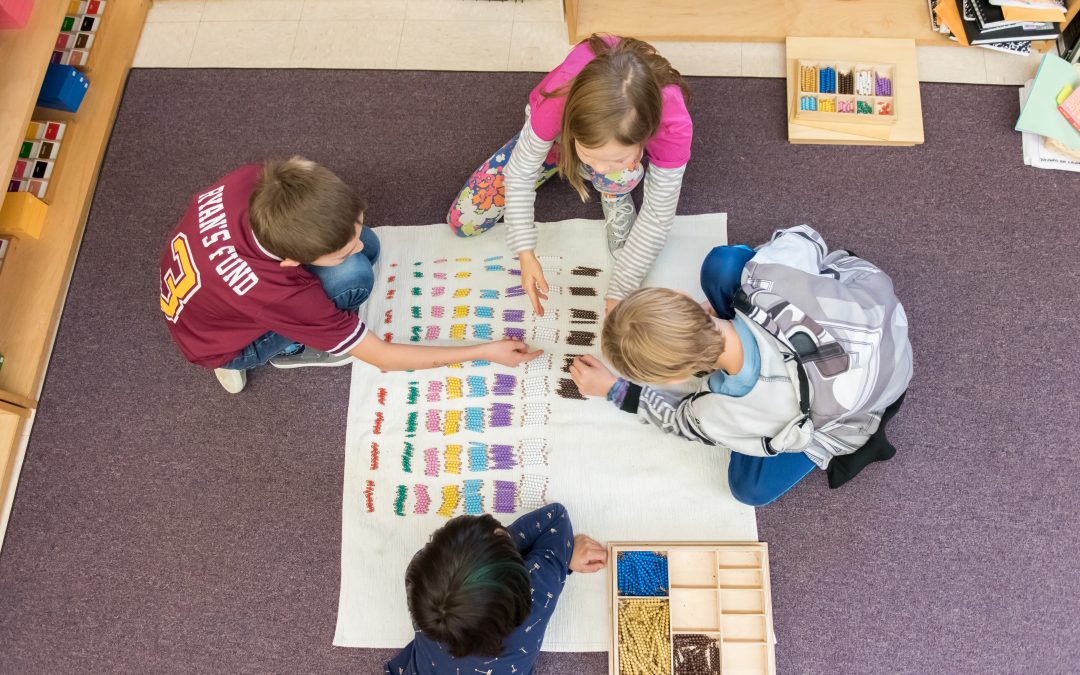
Whenever a teacher is not teaching, they are observing. They sit with students and watch how work is done. They ask questions to get students to describe their logic, process, and even fascination with a topic.
Teachers will note who is working solo, who is working with a younger or older student, and who is engaged in their work and who isn’t. They’re also on the lookout for one of the clearest signs of engagement and progress: “aha!” moments. These sparks of discovery come from dedicated blocks of uninterrupted work time where students can immerse themselves fully in a subject. These “aha!” moments can help lessons take on a life of their own.
Beyond individual progress, this level of observation provides a snapshot of where the class is as a whole. Are they helping one another? Are they showing respect for one another and the materials? When those questions can be answered with an unequivocal yes, teachers let students know how wonderful that is to see.
Assessing Mastery
One of the truest tests of whether or not a student has mastered a subject is if they can explain it. Once again, the teacher prompts the students to explain their logic or one of the key concepts of the lesson for example, “Can you show me how you got to this answer in your math work?” or “I’d love to hear why you chose to use an exclamation point at the end of your story.”
Another method for assessing mastery is the three-period lesson. Let’s say that the lesson is the Parts of a Mountain. In the first period, a set of cards with each mountain part is laid out and the teacher goes through each one explaining the meaning. In the second period, the cards are laid out, but the teacher asks the student if they can find the summit or slope. In the third period, the cards are once again laid out, but the teacher provides no information and simply asks the student if they can identify each of the cards without assistance.
As is true of any age, thorough mastery of a topic can be assessed in how you’re able to teach it to someone else. In the Montessori classroom, students can test their knowledge by explaining the lesson to a peer or younger student as the teacher watches on.
Self-Assessments
Self-reflection is another crucial component of tracking progress. Montessori students are taught to be reflective and practice metacognition, or thinking about their experience of learning. Teachers will meet with students individually to discuss the goals the student has, the goals the teacher has for them, how their work is going, what they’re looking forward to, and what support or resources could help them in their learning.
Self-assessments help students become proactive about their learning and take responsibility for their own progress. These are hallmarks of a Montessori education and skills that will serve them well in all aspects of life.
When we track progress through these methods, students are encouraged to develop independence, self-discipline, an enthusiasm for learning, and a respect for others. These types of qualities are just not inherent in a pop quiz or final exam.